Simplified Tax Invoice Requirements for Restaurants: 2026 Guide
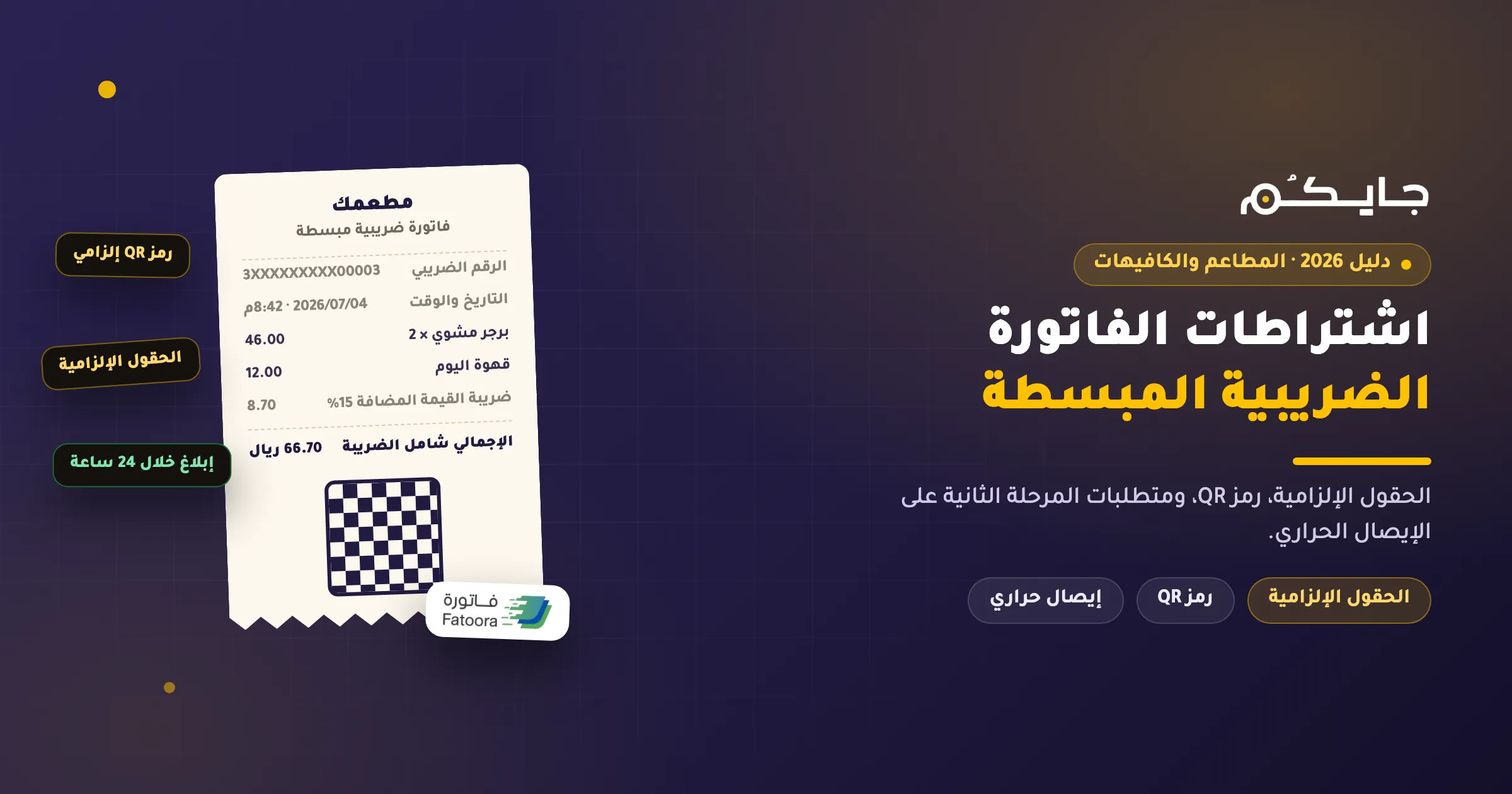
Key takeaways:
- A simplified invoice covers all your restaurant’s sales to end consumers at any value — the “1,000 SAR maximum” is a myth; the 1,000 SAR threshold applies only to the optional case of issuing one between two businesses.
- Since Phase 2, invoices must be generated in XML from a system integrated with the Fatoora platform, with a 9-tag QR code and a cryptographic stamp, and reported to ZATCA within 24 hours of issuance.
- Handing the customer a printed copy is mandatory (or an electronic copy if both parties agree), and no specific printer type is required — what matters is a clear, scannable QR code.
Every receipt that comes out of your restaurant’s POS is, in the eyes of the Zakat, Tax and Customs Authority (ZATCA), a “simplified tax invoice” — and any missing field on it (VAT number, QR code, issue time) can turn into a finding during a field visit and then a fine on repetition. With all integration waves completed on 30 June 2026, the question today is no longer “when should I prepare?” but “is my receipt actually compliant?” This guide walks through the simplified tax invoice requirements field by field, with a realistic restaurant receipt example, a table separating Phase 1 requirements from Phase 2 additions, and how to handle returns.
When Is a Simplified Invoice Enough? The Difference Between a Tax Invoice and a Simplified Invoice
The short answer: if your customer is an end consumer — a walk-in guest, a family at a table, a delivery order — a simplified invoice is enough at any value, even an 8,000 SAR dinner event. The full (“standard”) tax invoice is required for business-to-business (B2B) transactions in general, and for exports and intra-GCC supplies.
Let’s correct a widespread myth here: there is no “1,000 SAR maximum” for simplified invoices. The confusion comes from Article 53 of the VAT Implementing Regulations, which optionally allows issuing a simplified invoice between two registered businesses if the supply value is below 1,000 SAR. That threshold applies only to this optional B2B case — it has nothing to do with your sales to end consumers.
In practice, the difference between a tax invoice and a simplified invoice at your restaurant: the full invoice requires complete buyer details (name and VAT number) and goes through real-time Clearance by the platform before you share it, while the simplified invoice is handed to the customer immediately and reported afterwards. So if a company asks for an invoice in its name to deduct input VAT on a large amount, it needs a full tax invoice — which means your system must support both types.
Simplified Tax Invoice Requirements: The Mandatory Fields
The requirements come in two layers: the Phase 1 fields required on every receipt since 4 December 2021, and the technical additions imposed by Phase 2 (Integration) once your wave’s deadline arrived. The table below brings them together:
| Phase 1 (since 4 December 2021) | Phase 2 additions (Integration) |
|---|---|
| The title “Simplified Tax Invoice” visible on the receipt | Invoice generated in XML (or PDF/A-3 with embedded XML) |
| Sequential invoice number | UUID: a unique identifier for each invoice (a globally unique number generated automatically by the system) |
| Issue date | Issue time to the second (HH:mm:ss) |
| Supplier (restaurant) name and address | Tamper-proof invoice counter (ICV) that cannot be reset |
| Supplier’s VAT registration number | Previous invoice hash (a linked chain that prevents deleting any invoice) |
| Description of the good or service | Tax category code per line item |
| Unit price and quantity | Cryptographic stamp with the taxpayer’s own stamp via a CSID certificate |
| Line total including VAT | Extended QR code with 9 tags instead of 5 |
| Invoice total including VAT, with the VAT amount | Reporting the invoice to the Fatoora platform within 24 hours |
| A clear QR code on the printed copy | — |
Two important notes: the customer’s name is not mandatory on a simplified invoice except in specific cases (private healthcare and private education), and the issue time was not required in Phase 1 but became mandatory in Phase 2. All these technical additions should be handled automatically by your POS — your job is to confirm your system supports them; we detail the integration steps in our guide to ZATCA Phase 2 integration.
Anatomy of a Compliant Restaurant Receipt: Field by Field
Consider a thermal receipt from a fictional café, “Example Café” in Riyadh:
      Simplified Tax Invoice
          Example Café
    Olaya Main Street, Riyadh
VAT Number: 310123456700003
Invoice No: INV-2026-004518
Date: 2026-07-04   Time: 20:15:42
--------------------------------
Hot Latte          2 x 18.00 = 36.00
Cheese Croissant   1 x 12.00 = 12.00
--------------------------------
Total (excl. VAT)             41.74
VAT 15%                        6.26
Total Due                     48.00 SAR
--------------------------------
          [ QR code ]
Matching it against the requirements: the title “Simplified Tax Invoice” appears at the top, followed by the café’s name, address, and 15-digit VAT number. The sequential number INV-2026-004518 increments and is never reused, and the date is accompanied by the full time down to the second, as Phase 2 requires.
Each line item shows its description, unit price, quantity, and total; then the total before VAT (41.74 SAR), the VAT amount (6.26 SAR), and the total due (48.00 SAR). At the bottom sits a clear, uncropped QR code. The UUID, invoice counter, previous invoice hash, and cryptographic stamp live inside the XML file and never appear in print — but they exist, and they reach ZATCA when the invoice is reported.
One essential warning: a handwritten receipt or a scanned paper invoice does not count as an electronic invoice, even if saved as an image or PDF. An electronic invoice must be generated by a compliant invoicing system from the moment of issuance.
The QR Code on the Invoice: From 5 Tags to 9
The QR code on the invoice is not a decorative square — it is data encoded in a format called TLV (tag-length-value) converted to Base64, meaning every piece of information is stored inside the code in a structure ZATCA and its apps can read and verify.
Since Phase 1, the code has carried 5 tags: seller name, seller VAT number, timestamp, total including VAT, and total VAT amount. Phase 2 added 4 security tags: the XML file hash, the ECDSA digital signature (this is the “cryptographic stamp”: a digital signature proving the invoice came from your device and was not altered), the public key, and a ninth tag specific to simplified invoices — ZATCA’s signature over the taxpayer’s stamping key. The result: a full 9 tags in the simplified invoice’s QR code.
In practice, any customer can scan the code with ZATCA’s official VAT app to see your restaurant’s name, VAT number, and amounts — and if they don’t match, that’s a red flag for them and for an inspector alike.
Reporting Within 24 Hours, and Handling Returns
Unlike the full tax invoice, which is cleared in real time by the platform before being shared, the simplified invoice works on a “Reporting” model: it is stamped with the taxpayer’s own stamp and handed to the customer immediately — no waiting at the counter — then the system submits it to the Fatoora platform within 24 hours of issuance. A compliant POS batches and reports invoices automatically with no action from you.
As for returns — a daily reality in restaurants (a cancelled order, a wrong dish, a partial refund): deleting or editing an invoice after issuance is strictly prohibited; in fact, these are among the functions invoicing systems are banned from having at all. The correct approach is to issue an electronic credit note if the invoice value decreases (a refund) or a debit note if it increases, referencing the original invoice. The note follows its invoice’s type — a simplified note for a simplified invoice — with the same requirements and the same 24-hour reporting rule.
And remember that system shortcomings here carry a cost: a missing QR code or missing data fields starts with a warning on the first violation and then escalates through fines on repetition. We break down the full penalty ladders in our e-invoicing fines guide.
The Simplified Tax Invoice for Restaurants and Cafés Specifically
A restaurant is unlike any other business: dozens of invoices per rush hour, dine-in and delivery orders, instant refunds, and possibly multiple branches. These realities define what to demand from your system:
- Speed at the counter: the simplified invoice needs no real-time clearance, so your system must not add a single second to print time — stamping and reporting happen in the background.
- Offline mode: an internet outage must not stop sales; a good system issues invoices locally with the cryptographic stamp and reports them within the 24-hour window once the connection returns.
- Delivery app orders: every delivery order also needs a compliant simplified invoice, so make sure app orders flow into the same invoicing sequence rather than a separate, unintegrated system.
- Multiple branches: each POS device is an invoice-generating unit needing its own cryptographic certificate, and the Fatoora platform lets you issue up to 100 activation codes (OTPs) in one request to onboard branches together.
- Bilingual receipts: nothing prevents adding English alongside Arabic as long as the mandatory fields are complete and the QR code is clear.
Restaurant-built POS systems like Jaicome handle this entire chain — XML generation, stamping, the 9-tag QR code, and automatic reporting — while your staff simply print receipts as usual without ever touching the technical details.
One final advantage many miss: a valid simplified invoice is accepted as alternative evidence for input VAT deduction under Article 49(7) — meaning your small-business customers can use your compliant receipt in their VAT returns, which is an extra selling point for you.
Frequently Asked Questions
Is there a maximum value for a simplified tax invoice?
No — this is a common myth. A simplified invoice can be issued to an end consumer at any value, even above 1,000 SAR. The 1,000 SAR threshold applies to one case only: optionally issuing it between two registered businesses, where the supply value must be below 1,000 SAR.
Does a paper or scanned invoice count as an electronic invoice?
No. A handwritten or scanned invoice is not an electronic invoice, even if saved as an image or PDF. The invoice must be generated by a compliant invoicing system in XML or PDF/A-3 with embedded XML.
Do I have to print the simplified invoice for the customer?
Yes, handing the customer a printed copy is mandatory, though it may be shared electronically if both parties agree. There is no requirement for a specific printer type, thermal or otherwise; what is required is a clear, scannable QR code on the printed copy.
How can a customer verify a restaurant invoice is genuine?
The customer scans the QR code printed on the receipt using ZATCA’s official VAT app, which displays the seller’s details, VAT number, and amounts. If what appears in the app matches the receipt, the invoice is valid.
What do I do when an order is returned or I find an error in an issued invoice?
Invoices cannot be deleted or edited after issuance. Issue an electronic credit note if the value decreases or a debit note if it increases, referencing the original invoice, and report it to ZATCA within 24 hours just as you do with the invoice itself.
What is the fine for missing simplified invoice fields or a missing QR code?
Under the violations classification guide currently in force (issued May 2024), the first field violation ends with a warning and a correction period, no fine. Fines then escalate on repetition from 1,000 SAR up to 40,000 SAR, and the counter resets to a warning if 12 months pass after the last penalty decision.
Is a simplified invoice accepted for input VAT deduction?
Yes. Article 49(7) allows a valid simplified tax invoice to be accepted as alternative evidence for input VAT deduction, which helps businesses with small purchases valued below 1,000 SAR.
Conclusion
Simplified tax invoice requirements are not a list to memorize — they are a specification your POS must execute on your behalf: the Phase 1 fields on the printed receipt, and the XML, cryptographic stamp, 9-tag QR code, and 24-hour reporting in the background. Audit your current receipt against the example above, and check the official e-invoicing page for any updates.
And if you want a system built for this from day one: try Jaicome POS, compliant with ZATCA’s requirements — it issues and reports your simplified invoices automatically, stays fast during the rush, and keeps working even without internet.
Disclaimer: This article is for educational purposes only and does not constitute tax or legal advice. We always recommend consulting the official Zakat, Tax and Customs Authority website or a certified tax advisor.