ZATCA E-Invoicing Fines 2026: Amounts, Grace Periods, and Fixes
Key takeaways:
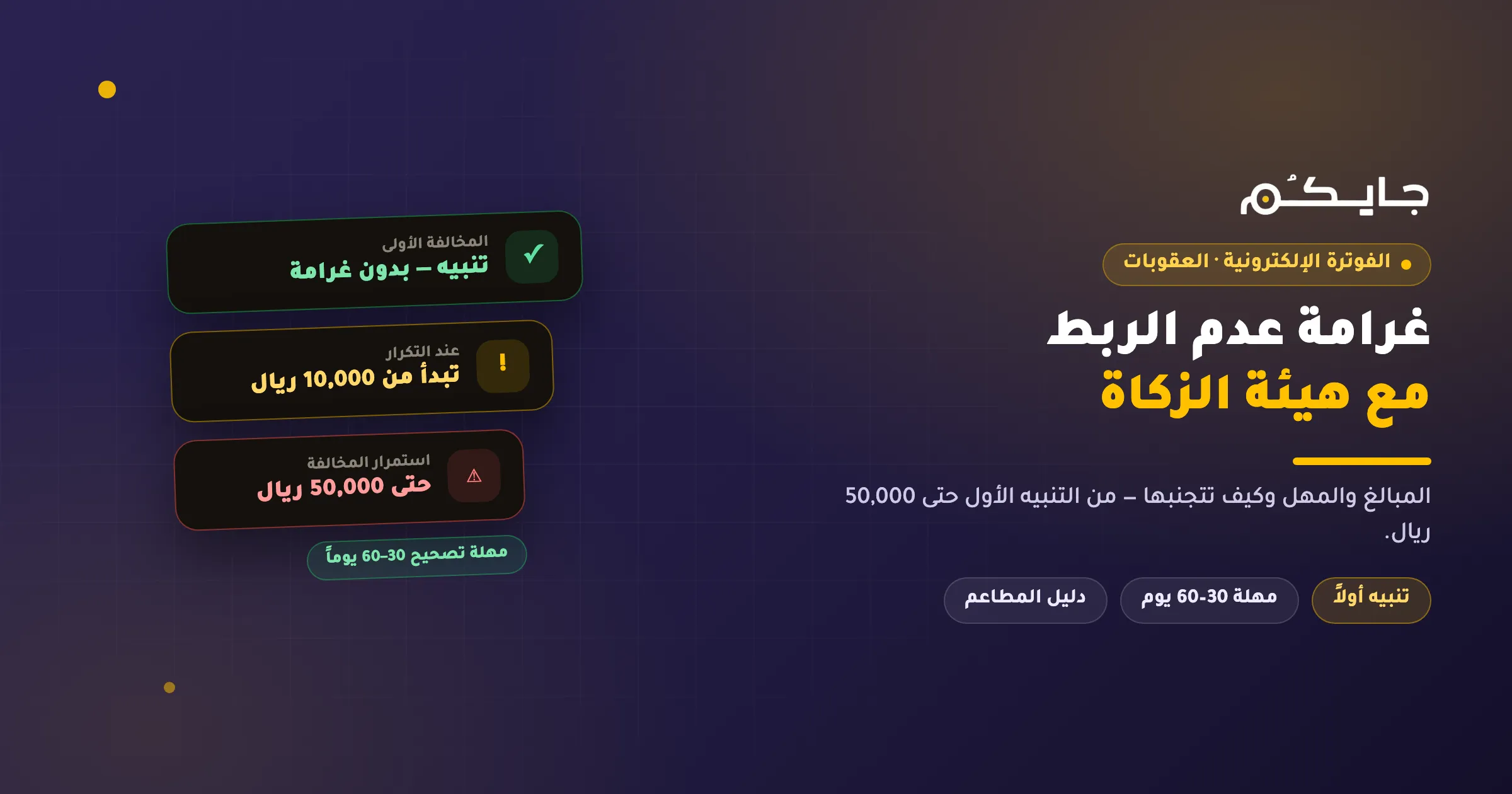
- Your first field violation carries no fine — you get a warning and a 30–60 day correction period, but repeat violations escalate the fine progressively up to SAR 50,000.
- The fine for failing to integrate with the Fatoora platform is the harshest: it starts at SAR 10,000 on the second violation and climbs to SAR 50,000 after the sixth.
- The fine cancellation initiative has been extended until 31 December 2026 — a real window to fix your restaurant’s compliance now, before any field inspection.
If you are searching for the “penalty for not integrating with the General Authority of Zakat and Tax,” you are using the authority’s former name — today it is the Zakat, Tax and Customs Authority (ZATCA) after its merger with Customs, but many restaurant owners still search by the old name. The question itself is entirely legitimate: the final integration deadline (Wave 24) passed on 30 June 2026, and every targeted business is now required to be actively integrated with the Fatoora platform. In this article we explain, with verified figures, how much ZATCA e-invoicing fines are, how the “warning first” principle works, and what to do if you missed your wave’s deadline or received a warning from the authority.
How Much Are ZATCA E-Invoicing Fines in 2026?
The direct answer: the first violation is a warning with no fine, then fines start at SAR 10,000 on the second violation and escalate up to SAR 50,000. This is per the Simplified Guideline for the Classification of General VAT Violations (second edition, May 2024) issued by the Zakat, Tax and Customs Authority — the version currently in force.
An important caution: you may still find older websites citing a different ladder (SAR 1,000 / 5,000 / 10,000 / 40,000). That schedule, announced in 2022, has been superseded — do not use it to estimate your risk.
Here is the current e-invoicing penalty table:
| Violation type | First violation | Fines on repetition (second onwards) | Follow-up cycle |
|---|---|---|---|
| Failure to integrate with the Fatoora platform | Warning + correction period | 10,000 → 15,000 → 20,000 → 30,000 → 40,000 → 50,000 SAR | Every 30 days |
| Failure to issue electronic invoices / deleting or editing invoices after issuance / prohibited system functions | Warning + correction period | 5,000 → 10,000 → 15,000 → 20,000 → 30,000 → 40,000 SAR | Every 30 days |
| Missing QR code / failure to notify ZATCA of an issue blocking issuance / missing data fields / failure to share the invoice with the customer | Warning + correction period | 1,000 → 5,000 → 10,000 → 20,000 → 30,000 → 40,000 SAR | Every 60 days |
There are statutory ceilings as well: general violations are capped at SAR 50,000 (Article 45 of the VAT Law), issuing a tax invoice by an unregistered person can reach SAR 100,000, and tax evasion is fined at no less than the tax due and up to 3 times the value of the goods or services.
One important fairness point: if you can prove the integration outage was caused by a failure in ZATCA’s own systems, you are exempt from the non-integration fine.
The “Warning First” Principle: A First Violation Does Not Mean a Fine
Since 30 January 2022, ZATCA has applied the “warning first” principle: when a field inspection uncovers an e-invoicing violation for the first time, the business receives a warning and guidance with no fine, plus a correction period of 30 to 60 days depending on the violation type (except obstructing ZATCA officers, which carries a 10-day period only).
The intent is compliance, not fine collection. But note three limits to this principle:
- It covers field violations only — not tax evasion, failure to file returns, or late payment.
- The correction period is not open-ended: if you do not fix the issue within the stated period, you move to the second violation and its actual fine.
- The warning is recorded — the next inspection does not start from zero.
The 12-Month Rule: When Is a Violation Considered “Repeated”?
A violation counts as repeated if it is detected again within 12 months of the last detection. If 12 months pass from the date of the penalty decision without repetition, the counter resets: a new inspection with a new violation starts again with a warning.
There is also an escalation rule you should know: the law allows doubling the fine if the same violation recurs within 3 years of the previous decision. The practical takeaway: fix the violation at its root rather than patching it, because repetition costs you multiples.
Other E-Invoicing Fines That Touch Your Daily Operations
Non-integration is not the only violation. Phase 2 penalties cover the entire invoicing chain, and these are the most common in the restaurant sector:
Fine for not issuing an electronic invoice: issuing handwritten paper invoices, or invoices from a non-compliant system, does not count as electronic issuance — and a scanned paper invoice is not an electronic invoice. The ladder here: a warning, then SAR 5,000, escalating up to SAR 40,000.
Deleting or editing invoices after issuance: POS systems that allow deleting or editing an issued invoice are themselves a violation (a prohibited function), even if you never use the feature. The correct way to handle returns is an electronic credit or debit note referencing the original invoice.
QR code fine: a missing QR code on the printed invoice, or one printed too poorly to scan, is a violation with a ladder of a warning, then SAR 1,000, escalating up to SAR 40,000. In Phase 2 the QR code contains 9 tags for simplified invoices (including the cryptographic stamp — a digital signature proving the invoice was not altered after issuance).
Failure to report an issue blocking issuance: if your system stops issuing invoices and you do not notify ZATCA, that is a standalone violation with the same ladder as the QR fine.
Phase 2 Penalties for Restaurants and Cafes Specifically
Restaurants are a high-risk environment in inspectors’ eyes for a simple reason: a large volume of simplified invoices (end-consumer invoices) is issued daily at the counter, and any system defect repeats hundreds of times a day. These are the most realistic scenarios:
A thermal receipt without a valid QR code: a customer receives a faded receipt or one with no code, or an inspector scans the code and ZATCA’s VAT app cannot read it. The violation is recorded on the spot during a field visit; what matters is a clearly scannable code on the printed copy, whatever the printer type.
A POS that issues invoices but is not integrated with Fatoora: many restaurants passed Phase 1 (invoices with a QR code) and assumed they were done, but never completed integration. A simplified invoice must be sealed with a cryptographic stamp via a CSID certificate (a unique digital identity for your POS device issued through the Fatoora platform) and reported to the platform within 24 hours of issuance. An unintegrated POS means the harshest ladder (up to SAR 50,000). See our full guide to ZATCA Phase 2 integration for restaurants for the requirements step by step.
A system that allows deleting orders after the invoice is issued: the traditional “void invoice” feature in legacy systems is now an explicit violation. A compliant system blocks deletion and generates a credit note for returns.
A note on rush-hour pressure: an inspector does not distinguish between an invoice issued during a quiet afternoon and one issued in the dinner rush. That is why the POS itself should enforce compliance automatically — modern systems such as the Jaicome POS issue the simplified invoice in the required format with the full QR code and handle reporting to the Fatoora platform without cashier intervention, even at peak times or with delivery-app orders. And if you are evaluating a new system, here is our checklist for choosing a ZATCA-compliant POS.
Missed Your Wave’s Deadline? Here Is What to Do Now
All 24 wave deadlines have passed — the last on 30 June 2026 for businesses whose taxable revenue exceeded SAR 375,000. If you are not yet integrated, further delay does not help you; every new field inspection after the first warning means a higher rung on the fine ladder. Check the wave deadline schedule to see where your business falls, then:
- Do not wait for a field inspection. Correcting proactively before detection is the best possible position.
- Get a compliant invoicing system that issues XML invoices (a structured data format ZATCA’s systems read automatically) with all Phase 2 requirements.
- Complete integration via the Fatoora platform at fatoora.zatca.gov.sa — an OTP activation code, then the compliance certificate, then the production certificate.
- Document every step — contract dates with your provider and support tickets help demonstrate good faith to the authority if needed.
Received a Warning from ZATCA? Your Steps During the Correction Period
A warning is not a fine — but it is a countdown clock. Handle it like this:
- Read the warning carefully: what exact violation was recorded, and what correction period were you given (between 30 and 60 days depending on the type)?
- Fix the root cause, not the symptom: if the violation is “incomplete QR code,” the real question is whether your system is genuinely Phase 2-ready or just patching Phase 1.
- Contact your system provider immediately and request written confirmation that the fix covers the cited violation item.
- Ask ZATCA directly about anything unclear: the unified number 19993 operates around the clock, along with @Zatca_Care on X and [email protected].
- Keep proof of correction before the period ends — a valid test invoice, screenshots from the Fatoora platform showing successful submission.
Remember the 12-month rule: serious correction today means any future finding more than 12 months after the penalty decision starts again with a warning, not a fine.
The Fine Cancellation Initiative: A Window Open Until 31 December 2026
On 29 June 2026, ZATCA announced the extension of the fine cancellation and financial penalty exemption initiative from 1 July until 31 December 2026. The initiative covers fines for late registration, late payment, late filing, and return corrections, provided the business is registered, files its returns, and pays the principal tax due (with installment plans available). It excludes tax evasion violations and fines already paid.
One point worth attention: the previous round of the initiative (January–June 2026) explicitly covered field-detection fines for e-invoicing, while the latest extension announcement did not mention them by name — so we recommend verifying the current scope of coverage directly via 19993 or the e-invoicing page on ZATCA’s website before relying on it. Either way, the message is clear: this is a correction window, not a grace to relax.
Frequently Asked Questions
How much is the fine for not integrating with the Fatoora platform?
The first violation is a warning with no fine plus a correction period, then SAR 10,000 on the second violation, escalating to 15,000, 20,000, 30,000, 40,000, and up to SAR 50,000 after the sixth. Follow-up occurs every 30 days. You are exempt if you prove the failure was caused by ZATCA’s own systems.
Does a first e-invoicing violation carry a fine?
No. Since 30 January 2022, the Zakat, Tax and Customs Authority applies the “warning first” principle: the first field violation results in a warning and guidance with no fine, plus a correction period of 30 to 60 days depending on the violation type. Financial fines start from the second violation.
I missed my wave’s integration deadline — what should I do?
Correct your situation immediately and do not wait for a field inspection: get an invoicing system compliant with Phase 2, complete the integration steps via the Fatoora platform, and document the dates of every step. Acting proactively before detection puts you in the best position, and a first detected violation is still a warning that grants you a correction period.
How much is the fine for a missing QR code on the invoice?
The QR code fine starts with a warning on the first violation, then SAR 1,000 on repetition, escalating to 5,000, 10,000, 20,000, 30,000, and up to SAR 40,000, with follow-up every 60 days. The requirement is a clear, scannable code on the printed copy of the simplified invoice.
Does the fine exemption initiative cover e-invoicing fines?
The initiative extended until 31 December 2026 covers fines for late registration, late payment, late filing, and return corrections. The January–June 2026 round explicitly covered field-detection fines for e-invoicing, but the extension announcement did not mention them by name, so verify the scope of coverage via the unified number 19993 before relying on it.
When is a violation considered repeated so the fine increases?
A violation counts as repeated if it is detected again within 12 months of the last detection, moving you to the next rung on the fine ladder. If 12 months pass from the penalty decision without repetition, the count restarts with a warning. The fine may also be doubled if the same violation recurs within 3 years.
Bottom Line: Compliance Is Cheaper Than Any Fine
The e-invoicing fine ladder is designed to give you a fair chance: a first warning with no fine, a clear correction period, and a counter that resets after 12 months of compliance. But it escalates without mercy when neglected — up to SAR 50,000 for non-integration. For a restaurant owner, the math is simple: a compliant POS system costs far less than a single second-violation fine.
Try the Jaicome POS, built to meet ZATCA’s requirements — simplified invoices stamped and QR-coded automatically, with Fatoora platform integration running in the background even at peak hours, so you can focus on your restaurant instead of chasing violations.
Disclaimer: This article is for educational purposes only and does not constitute tax or legal advice. We always recommend referring to the official website of the Zakat, Tax and Customs Authority or consulting a certified tax advisor.