ZATCA Integration Deadlines: Full Wave Table — And What Comes Next?
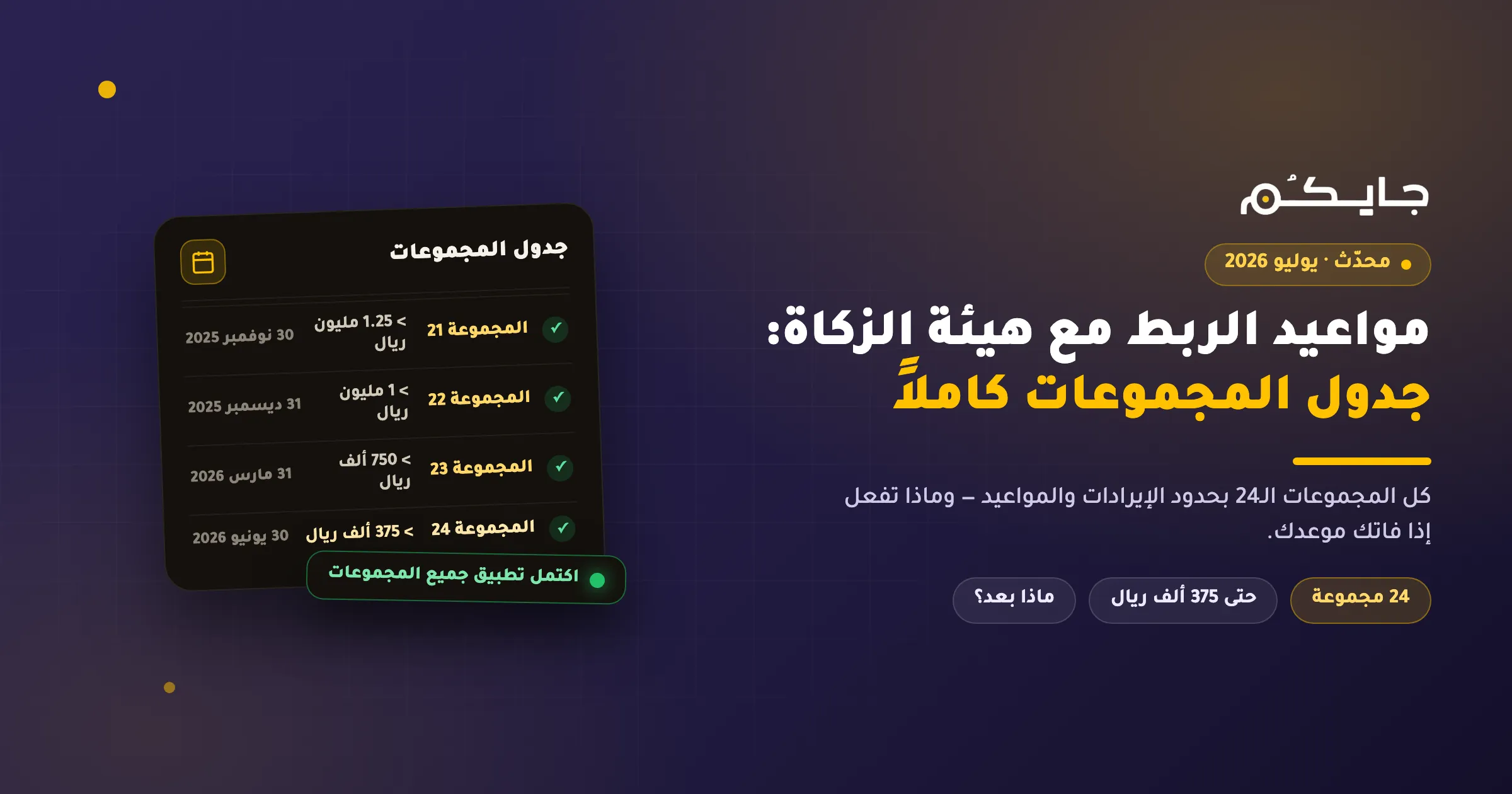
Key takeaways:
- All ZATCA integration deadlines have now passed: Wave 24 was the last one, its deadline expired on June 30, 2026, and Phase 2 integration now applies to every VAT-registered business.
- If your VAT-taxable revenue exceeded SAR 375,000 (the mandatory VAT registration threshold) in any year from 2022 to 2024, you are within Phase 2 scope — check the full table below.
- Missed your wave’s deadline? Don’t panic: the “warning first” principle gives you a correction window before any fine, and the penalty-cancellation initiative is extended until December 31, 2026 — but integrate now.
Last updated: July 4, 2026 — we review this table regularly against every new announcement from the Zakat, Tax and Customs Authority.
If you own a restaurant or café and are searching today for ZATCA integration deadlines, here is the direct answer: they have all passed. The final wave (Wave 24) closed on June 30, 2026, and the Authority has announced no new wave since. The real question is no longer “when is my deadline?” but “am I actually compliant — and what do I do if I’m not?”
In this article you will find the complete table of all 24 waves so you can locate your restaurant, exactly what to do if you missed your deadline, and what full rollout means for a new restaurant opening today.
What Are the Integration Waves, and Why Were Businesses Grouped?
E-invoicing in Saudi Arabia rolled out in two phases. Phase 1 (Generation) started on December 4, 2021 for all taxpayers, requiring invoices to be issued from an electronic system instead of paper books. Phase 2 (Integration) started on January 1, 2023 and requires connecting your POS system directly to the Authority’s Fatoora platform, so your invoices reach ZATCA electronically.
Because connecting hundreds of thousands of businesses at once was impractical, the Authority split taxpayers into successive integration waves by VAT-taxable revenue: starting with the largest companies (over SAR 3 billion) and ending with the smallest registered businesses. ZATCA notified each wave at least six months before its deadline, through direct notification to targeted businesses plus a public announcement.
We covered Phase 2 and its full technical requirements in our ZATCA Phase 2 integration guide for restaurants.
ZATCA Integration Deadlines: The Complete 24-Wave Table
Find the highest VAT-taxable revenue your restaurant reached in the measurement years, and you will know your wave and the deadline you were expected to meet:
| Wave | Taxable revenue threshold | Measurement years | Integration period |
|---|---|---|---|
| 1 | Over SAR 3 billion | 2021 | Jan 1 – Jun 30, 2023 |
| 2 | SAR 500 million – 3 billion | 2021 | Jul 1 – Dec 31, 2023 |
| 3 | Over SAR 250 million | 2021 or 2022 | Oct 1, 2023 – Jan 31, 2024 |
| 4 | Over SAR 150 million | 2021 or 2022 | Nov 1, 2023 – Feb 29, 2024 |
| 5 | Over SAR 100 million | 2021 or 2022 | Dec 1, 2023 – Mar 31, 2024 |
| 6 | Over SAR 70 million | 2021 or 2022 | Jan 1 – Apr 30, 2024 |
| 7 | Over SAR 50 million | 2021 or 2022 | Feb 1 – May 31, 2024 |
| 8 | Over SAR 40 million | 2021 or 2022 | Mar 1 – Jun 30, 2024 |
| 9 | Over SAR 30 million | 2021 or 2022 | Jun 1 – Sep 30, 2024 |
| 10 | Over SAR 25 million | 2022 or 2023 | Oct 1 – Dec 31, 2024 |
| 11 | Over SAR 15 million | 2022 or 2023 | Nov 1, 2024 – Jan 31, 2025 |
| 12 | Over SAR 10 million | 2022 or 2023 | Dec 1, 2024 – Feb 28, 2025 |
| 13 | Over SAR 7 million | 2022 or 2023 | Jan 1 – Mar 31, 2025 |
| 14 | Over SAR 5 million | 2022 or 2023 | Feb 1 – Apr 30, 2025 |
| 15 | Over SAR 4 million | 2022 or 2023 | Mar 1 – May 31, 2025 |
| 16 | Over SAR 3 million | 2022 or 2023 | Apr 1 – Jun 30, 2025 |
| 17 | Over SAR 2.5 million | 2022 or 2023 | May 1 – Jul 31, 2025 |
| 18 | Over SAR 2 million | 2022 or 2023 | Jun 1 – Aug 31, 2025 |
| 19 | Over SAR 1.75 million | 2022 or 2023 | Jul 1 – Sep 30, 2025 |
| 20 | Over SAR 1.5 million | 2022 or 2023 | Aug 1 – Oct 31, 2025 |
| 21 | Over SAR 1.25 million | 2022, 2023 or 2024 | Sep 1 – Nov 30, 2025 |
| 22 | Over SAR 1 million | 2022, 2023 or 2024 | Oct 1 – Dec 31, 2025 |
| 23 | Over SAR 750,000 | 2022, 2023 or 2024 | Jan 1 – Mar 31, 2026 |
| 24 | Over SAR 375,000 | 2022, 2023 or 2024 | Apr 1 – Jun 30, 2026 |
Note that wave 23 of e-invoicing (announced June 27, 2025) and Wave 24 (announced September 26, 2025) covered a very large share of small and medium restaurants and cafés, because the Wave 24 threshold — SAR 375,000 — equals exactly the mandatory VAT registration threshold. In other words: every VAT-registered business is now within integration scope.
How Do You Know Your Restaurant Is Within Phase 2 Scope?
The rule is simple: compare your VAT-taxable revenue in 2022, 2023, and 2024 against the table above. If you exceeded SAR 375,000 in any of those years, you are in scope, and your wave is determined by the highest bracket you reached.
The Authority did not leave this to guesswork — it notified each wave at least six months before its deadline. If you ever received a ZATCA notification and ignored it, your deadline has passed and you are now non-compliant. If you are unsure whether a notification arrived, the safest assumption is that you are in scope as long as you are VAT-registered, and verify directly through the Authority’s 24/7 unified number 19993.
Missed the Last ZATCA Integration Deadline? Here’s What to Do, In Order
First: keep issuing invoices, but integrate immediately — every day of delay increases the chance of the violation being discovered in a field inspection. Integration starts on the Fatoora platform by generating an OTP activation code and entering it in your POS system; we explained the steps in detail in the Phase 2 guide linked above.
Second: rest assured regarding immediate penalties. The Authority applies the “warning first” principle: the first field-detected violation results in a warning and guidance with no fine, plus a correction window of 30 to 60 days depending on the violation type. Fines start on repetition after the warning, and for failure to integrate with the Fatoora platform they escalate up to SAR 50,000 at advanced repetitions. Full penalty ladders are in our ZATCA e-invoicing fines and penalties article.
Third: take advantage of the penalty-cancellation and exemption initiative, extended from July 1 to December 31, 2026. It covers registration, payment, and late-return fines, provided you register, file your returns, and pay the principal tax (installments allowed). The previous round explicitly included field-inspection e-invoicing fines; the extension announcement did not name them explicitly — so we recommend verifying the coverage scope via 19993 or @Zatca_Care on X.
What Does Wave Completion Mean for a New Restaurant Opening Today?
Completion of the 24 waves does not mean new businesses are exempt — quite the opposite: the era of “waiting for your turn” is over. A restaurant opening today that registers for VAT (mandatory once revenue exceeds SAR 375,000) will fall within integration scope, and the practical move is to start from day one with an invoicing system that already meets Phase 2 requirements rather than buying an ordinary POS and replacing it later.
As of this article, the Authority has not announced a Wave 25 or a new mechanism for later entrants, so follow the official e-invoicing page for updates, or ask via 19993.
ZATCA Integration Deadlines for Restaurants and Cafés Specifically: Why Were They the Hardest?
Most restaurants and cafés fell into the later waves (17 through 24) and faced a challenge a contracting firm never does: massive daily invoice volume. A restaurant issues simplified tax invoices to consumers all day long, and every one of them must be cryptographically stamped, carry a 9-tag QR code, and be reported to the Authority within 24 hours — without slowing the counter queue at rush hour.
This is where the gap shows between a POS that merely “prints receipts” and one built for compliance: handling internet outages without stopping sales, merging delivery-app orders into the same invoice sequence, and connecting multiple branches with multiple devices (the Fatoora platform allows issuing up to 100 OTP codes in one request for exactly this). Systems like Jaicome POS were designed around this scenario from the start: a compliant simplified invoice printed in seconds, an offline mode that stores invoices and reports them the moment connectivity returns, and multi-branch management from a single dashboard.
If you have not integrated yet, or doubt your current system meets the requirements, start verifying today before the first field inspection — correcting now is far cheaper and calmer than correcting under a warning deadline.
Frequently Asked Questions
How do I know if my restaurant is within Phase 2 scope?
Compare your VAT-taxable revenue in 2022, 2023, or 2024 against the wave table: if it exceeded SAR 375,000 in any of those years, you are in scope. The Authority also directly notified targeted businesses at least six months before each wave’s deadline. To confirm, contact ZATCA on the unified number 19993.
Is there a Wave 25 after Wave 24?
No. As of July 4, 2026, the Zakat, Tax and Customs Authority has announced no wave beyond Wave 24, whose deadline expired on June 30, 2026. Since the Wave 24 threshold equals the mandatory VAT registration threshold (SAR 375,000), the rollout has effectively covered all registered taxpayers.
What should I do if I missed the last ZATCA integration deadline?
Integrate immediately through the Fatoora platform and do not wait for a field inspection. If the violation is detected for the first time, you receive a warning with no fine and a correction window of 30 to 60 days; fines begin on repetition. Also consider the penalty-cancellation initiative extended until December 31, 2026, after verifying its coverage scope.
When was the wave 23 e-invoicing deadline?
Wave 23 covered businesses whose taxable revenue exceeded SAR 750,000 in 2022, 2023, or 2024, with an integration period from January 1 to March 31, 2026, announced by the Authority on June 27, 2025. Its deadline has passed — if you were in it and have not integrated, correct course now.
My restaurant is new with revenue under SAR 375,000 — do I have to integrate?
As long as you are not VAT-registered (because you are below the mandatory registration threshold), you are currently outside e-invoicing scope. But once you cross the threshold and register for VAT, you enter compliance scope, so it is wise to choose a Phase 2-compliant POS system from the start.
What is the fine for not integrating with the Fatoora platform?
The first field-detected violation results in a warning with no fine plus a correction window. On repetition, the fine starts at SAR 10,000 and escalates up to SAR 50,000 after the sixth occurrence, per the simplified guide to VAT violation classification (second edition, May 2024).
Will anyone notify me of my deadline, or must I follow up myself?
The Authority notified each wave’s businesses directly at least six months before the deadline, in addition to the public announcement. Now that all 24 waves are complete, there is no “upcoming deadline” to wait for — compliance is required now for every VAT-registered business, and monitoring the Authority’s official channels remains your responsibility.
Bottom Line: The Deadlines Are Over — Compliance Remains
The ZATCA integration deadline table is now a reference for verification, not for waiting: 24 waves completed, the last on June 30, 2026, and every VAT-registered restaurant must be integrated now. If you are compliant, make sure your system keeps reporting smoothly; if you missed your deadline, the path is clear: integrate immediately and benefit from the warning-first principle and the exemption initiative before the end of 2026.
Try Jaicome POS, compliant with ZATCA requirements — cryptographically stamped simplified invoices, automatic reporting to the Fatoora platform, an offline mode that never stops your sales, and multi-branch management in one place.
Disclaimer: This article is for educational purposes only and does not constitute tax or legal advice. We always recommend referring to the official Zakat, Tax and Customs Authority website or consulting a certified tax advisor.